
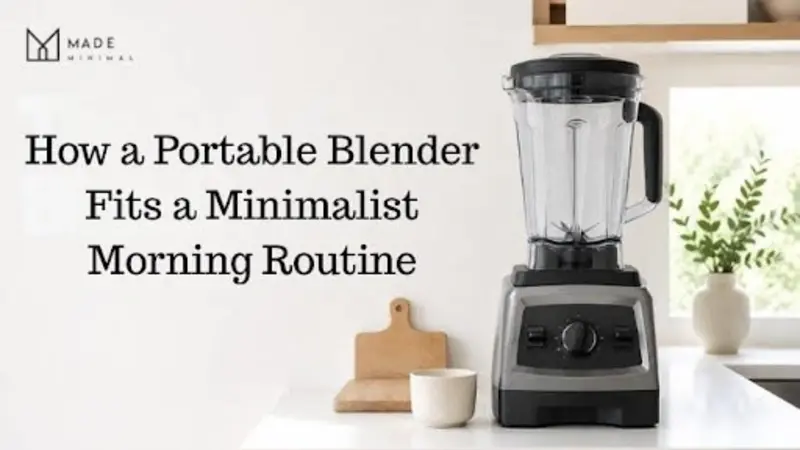
A portable blender can simplify your mornings, but only if it genuinely fits your routine. How a Portable Blender Fits a Minimalist Morning Routine
A portable blender fits a minimalist morning routine by making breakfast a one-step job. Fruit, liquid, and ice go into a single cup, and you’re done in under a minute.
That kind of simple routine is what we value at Made Minimal, a Brisbane-based store built around practical products for everyday life. And we know that a quick process can be especially useful at breakfast. In fact, limited time for preparation and cleanup is one reason adults skip their morning meal.
Of course, adding another gadget sounds odd for a minimalist. But let’s not forget that minimalism is about keeping things that reduce effort and decisions. In this article, we’ll cover how a portable blender does exactly that.
Build a Minimalist Morning Routine With a Portable Blender
A minimalist morning routine works best when each habit takes minimal effort to repeat. The fewer decisions you face before breakfast, the easier it is to stay consistent every single day.
Let’s look at a few ways to set that up around your portable blender.
Reduce Breakfast Decisions
Small choices can pile up fast in the morning: what to eat, what to grab, and where you left the blender lid. All of that burns through your attention before your day even starts.
A simple fix is to pick two or three smoothie combinations you like and rotate them through the week. For example, banana and oats on Monday, berries and spinach on Wednesday, and mango with yoghurt on Friday. Group those ingredients together in the fridge or pantry so everything is within arm’s reach.
If something needs a bit of prep, like chopping harder fruit or portioning frozen berries, we recommend doing it the night before (a good morning routine really does start the evening prior).
Just don’t turn breakfast into a whole productivity system. The moment it feels complicated, you’ve added stress instead of removing it.
Create a Five-Step Smoothie Routine
A repeatable process takes the guesswork out of breakfast entirely. These five steps can make your portable blender a one-minute morning habit, and they work the same way every single day:
- Prepare: Keep a few basic ingredients on hand. Frozen fruit, yoghurt, and milk or juice are enough for most smoothie combinations.
- Fill: Only add what you’ll drink in one sitting. Most portable blenders hold between 350 and 600 mL, which is sufficient for one serving without overfilling.
- Blend: Now you just press the button and walk away for 30 seconds. Soft fruit and liquid blend quickly, but skip large ice cubes or rock-hard frozen chunks, since portable motors can struggle with them. And that can slow down your morning or put extra strain on the blender.
- Drink: Your morning schedule shouldn’t force you to sit down. Portable blenders are compact enough to fit in a bag or car cup holder, so breakfast travels with you.
- Reset: Drop in some warm water and a single drop of dish soap, run a quick 10-second blend cycle, then rinse and dry. The whole cleanup should wrap up in under 30 seconds.
That’s the entire routine from start to finish. This way you’ll have no extra bowls, stovetop, or any waiting around.
Make On-the-Go Smoothies Genuinely Convenient
On-the-go smoothies should save you steps. You blend and drink from the same cup, so there’s one less container to wash compared to a full countertop setup.
Early workouts and commutes are where portability helps most. And USB charging lets you recharge the blender at your desk, in the car, or with a power bank while travelling.
Noise is worth thinking about too, especially early in the morning. Luckily, portable blenders run between 60 and 75 decibels (roughly the volume of a normal conversation). So if you share your space with a partner or housemates, you can blend without waking anyone at 6 am.
Pro Tip: Keep the blender somewhere easy to reach without cluttering your bench. A drawer, a shelf, or the corner of your countertop all work fine. The goal is to make breakfast easy enough to repeat each morning.
How a Portable Blender Fits Into Simple Living
A portable blender earns its spot in a minimalist kitchen when it genuinely removes effort from your morning. So the real test is whether it simplifies your day or becomes another thing to manage. Here’s how to figure that out.
Put Small Kitchen Gadgets Through a Minimalist Test
Simple living means being honest about which gadgets you’ll actually reach for on a regular basis. With that in mind, it helps to ask a few practical questions before buying a portable blender.
The first one is frequency. If you’ll only blend a smoothie once a fortnight, the gadget will probably end up forgotten in a drawer. But if breakfast smoothies are something you’d make three or four times a week, buying one makes much more sense.
Once you’ve figured that out, think about what the blender actually replaces. For instance, does it reduce chopping, cooking, or washing up, or does it simply replace those tasks with different ones? Because a blender that replaces one set of tasks with another may not actually make your morning routine any easier.
It’s worth comparing the cleanup against your current breakfast routine. For example, if you’re already eating toast in two minutes, a blender might not save you anything at all. And finally, before buying one, check whether you already have something that can handle the same job. A stick blender may be enough, or a jar and fork could work for simpler mixtures.
In the end, you should choose the option that gives you a useful benefit without taking up extra space.
Consider the Everyday Limitations
No gadget is perfect, and a portable blender is no exception. Knowing the trade-offs upfront makes it much easier to decide whether the blender suits your routine or just sounds good in theory. These are a few common limitations worth keeping in mind:
- Frozen Ingredients: Portable blenders offer less motor power than full-sized countertop models. Large ice cubes and rock-hard frozen fruit can stall the blades, so it helps to chop or slightly thaw ingredients before you blend them.
- Battery: USB charging is convenient, but it’s still one more task to remember each week. Most models deliver 10 to 20 blends per charge, and that battery performance drops after roughly 300 to 500 charge cycles.
- Cleaning: A quick rinse with warm water and soap handles most residue after a standard smoothie. However, thicker mixtures like nut butter or oats tend to stick around the blades, and that takes a bit more scrubbing to sort out.
- Capacity: Most portable blenders hold between 350 and 600 mL, so they’re built for single servings only. If you’re feeding more than one person each morning, a single blend won’t cover it.
- Weight: The word “portable” doesn’t always mean light. Some models weigh over a kilogram when full, so keep that in mind if you plan to carry yours in a bag every day.
- Money: A decent portable blender costs anywhere from $30 to $150. If your current breakfast setup already works well, spending that money on a new gadget might not be the best use of it.
Beyond these specifics, it’s also worth remembering that not every portable blender performs the same way. Motor power, battery size, and build quality vary widely across brands. So read a few detailed reviews before you commit to save you a lot of frustration down the line.
Test the Routine for a Single Day
Before you overhaul your mornings entirely, try a simple one-day experiment first. Pick a day when your schedule looks normal and run the full routine from prep to cleanup (just as you would on any regular morning).
As you go, pay close attention to whether breakfast feels easier or more complicated than usual. It also helps to count the dishes at the end of the process. With a portable blender, it should really only be the cup, the lid, and nothing else.
After your test day, ask yourself one simple question: does life feel a bit lighter with this routine in it? If the answer is yes, extend the experiment to a full week. That’s enough time to tell whether the habit will genuinely stick or it was just the excitement of trying something new.
Either way, you’ll walk away with an honest answer, and that’s really all a minimalist needs to make a good decision.
Choose a Portable Blender for Simple Living
Good routines cut down on morning decisions instead of adding to them. That’s the whole point of simple living, and it’s the same test any small kitchen gadget should pass.
A portable blender won’t suit every minimalist kitchen, and that’s fine. If your current breakfast already works, there’s no need to change it. But if you drink smoothies regularly, work out early, or commute with breakfast in hand, the convenience can genuinely save you time.
At its core, minimalism is about connecting what you own to how you actually live. So keep what’s useful, let go of what isn’t, and build a morning worth repeating.
Ready to simplify your morning routine? Explore portable blenders and more practical everyday products at Made Minimal.